
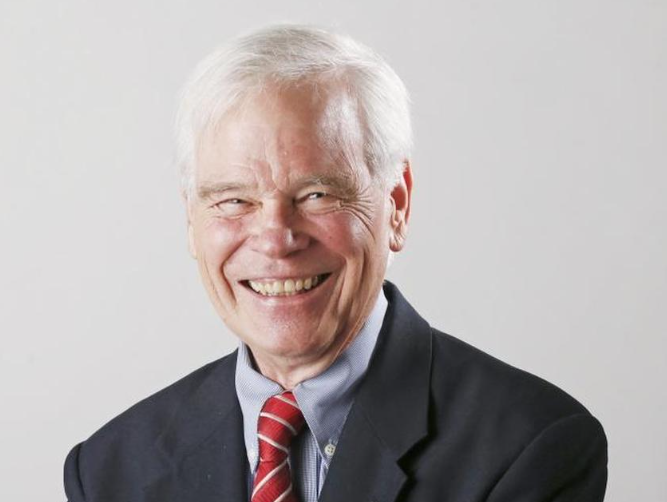
David Grier Martin, Jr., known to all as D.G., died December 9, 2025, at his home in Chapel Hill, North Carolina, with his wife by his side. He was 85. Though born in Atlanta on May 24, 1940, and a childhood resident of Bristol, Tennessee, he grew up from age 10 in Davidson, North Carolina, and was a fervent North Carolinian, graduating from North Mecklenburg High School in 1958 and four years later with honors from Davidson College, where his father served as president from 1958 to 1968. As D.G. would be first to tell, he played basketball for the Davidson Wildcats under Coach Lefty Driesell and captained Lefty’s first-ever winning college basketball team. To this day the Wildcat basketball team annually presents the “D.G. Martin Hustle Award” to the player who best epitomizes D.G.’s tenacious style of play.
D.G. was a proud Davidson alumnus, a devout Presbyterian, a Green Beret with the U.S. Army’s Special Forces, a lawyer, an author, a newspaper columnist, a radio and television personality, and a public servant. Nothing on his resume, though, captured the power of his smile, which attracted friends of all ages and circumstances. He made friends everywhere he went, from the roadside restaurants he wrote a book about, to Sutton’s Drugstore on Chapel Hill’s Franklin Street where he was a regular, to libraries, bookstores, and civic clubs across the state. D.G. was a lifelong learner with an insatiable curiosity and a teacher, too, always happy to share what he knew.
He met his wife, Harriet Wall, of Conway, South Carolina, on a blind date in 1963 while in the Army. They were married in 1966 after his first year at Yale Law School. After he completed his law degree, they moved to Charlotte, where D.G. practiced law for 20 years with the firm of Kennedy, Covington, Lobdell, and Hickman.
In Charlotte, D.G. and his family were members of Seigle Avenue Presbyterian Church, a small, inner-city church where he served as an Elder and Sunday school teacher. He served as moderator of the Mecklenburg Presbytery and the Presbyterian Synod of the Mid-Atlantic.
D.G., a steadfast Democrat, famously ran for the U.S. House of Representatives in 1984 and 1986 in a staunchly Republican district in Charlotte. On his first attempt in 1984, he lost by a mere 327 votes (0.2%). Another attempt in 1986 was also unsuccessful. Despite losing these elections, he won the lasting gift of meaningful friendships across the state.
In 1988, D.G. was recruited to the University of North Carolina System as secretary and later moved to the position of vice president for public affairs. There, he built relationships across both sides of the aisle. His knowledge of the state and the university system, his intellect, his integrity, and his genuine relationships made him an ideal representative for the university system at the legislature. He gained the respect and admiration of all he encountered, no matter their views on political issues.
After retiring from the University in 1997, D.G. ran for the Democratic nomination for the U.S. Senate, strengthening his already deep ties with people throughout the state. Though not elected, he embodied a form of principled, thoughtful leadership that was both heartening and inspiring.
D.G. served six-month appointments as interim vice chancellor at both UNC–Pembroke and North Carolina Central University. He later led the North Carolina Clean Water Management Trust Fund, the Trust for Public Land’s North Carolina office, and the Triangle Land Conservancy, and also served for two years as president of the William R. Kenan Funds.
Simultaneously, over the last 30 years, he hosted close to 450 episodes of North Carolina BookWatch on UNC-TV, wrote a weekly newspaper column called One on One that ran in many papers across the state, recorded a WCHL radio interview program called Who’s Talking, and wrote two editions of the UNC Press book, Roadside Eateries, about places in North Carolina with good food and low prices run by likeable Tar Heels. For his service to the state, he became the 53rd recipient of the annual North Caroliniana Society Award.
In addition to his public service, D.G. was an exceptionally devoted grandfather. He reveled in his grandchildren and delighted in everything they did, from birth to toddlerhood, into teen years and early adulthood. A fiercely proud, gentle grandparent, he was first in line for babysitting, diaper changing and preschool pickup and in the front row for ballgames and school plays. He made piles of pancakes, played endless games of all types, and cheered and coached them in their academic, social, and athletic endeavors.
In addition to a massive hoard of books, foreign language dictionaries, maps, atlases, and National Geographic magazines, he loved, collected, and rode bikes of all kinds. His bookshelf overflowed with spiral notebooks full of notes about people he met, places he visited, and sermons, lectures, or meetings he attended. He was often spotted jogging the roads of Chapel Hill or riding his bike around campus, greeting and chatting with all he encountered.
He is survived by his wife of more than 59 years, Harriet Wall Martin, his children Grier Martin (Louise) of Raleigh and May Bryan (Cotton) of Chapel Hill, beloved grandchildren Sara Martin and Maggie, Jake, and David Bryan. His sister Embry Howell (Joe), and multitudes of dear nieces, nephews, cousins, and friends also survive him. He was preceded in death by his mother, Louise McMichael Martin, his father, David Grier Martin, Sr., and his brother, Jack McMichael Martin.
The family extends their deep gratitude to D.G.’s friends and caregivers, David Gitata and Cecil Macaully, for the heartfelt care and unwavering devotion they have shown in the past few months.
In lieu of flowers, please consider a donation to University Presbyterian Church (209 E. Franklin Street, Chapel Hill, NC 27514), or to Triangle Land Conservancy (PO Box 1848, Durham, NC 27702).
A memorial service will be held at University Presbyterian Church in Chapel Hill on Saturday, January 3, 2026 at 11 am. The service will be live-streamed and recorded. https://upcch.org/live
From The Charlotte Observer:
by Nora O’Neill, December 9, 2025
David Grier “D.G.” Martin Jr., a former University of North Carolina system vice president, congressional candidate, lawyer and the host of UNC-TV’s North Carolina Bookwatch for two decades, died early Tuesday at his home in Chapel Hill, his son said. He died with his wife by his side after a battle with melanoma. He was 85.
Martin ran twice for a Charlotte-based seat in Congress in the 1980s before shifting into higher education, where he became a top official in the University of North Carolina system and later its chief legislative liaison. After leaving that role in the late 1990s and losing a bid for the U.S. Senate, he spent decades as a weekly columnist and the host of North Carolina Bookwatch. A former UNC System president called him “a wonderful representative and ambassador” for the state.
He was described by friends and family as exceptionally kind, friendly and curious.
“He was a dad who never really told us what to do, but he was a dad who just set an example,” his son, Grier Martin, said in an interview with The Charlotte Observer. “He led by example, rather than order, and set a model for what a parent should be, what a man should be, what a human being should be.”
Martin grew up in Davidson, where his father, David Grier Martin, served as president of Davidson College from 1958 to 1968. He graduated from North Mecklenburg High School and Davidson College, where he played on the basketball team, according to the North Caroliniana Society. He later served in the U.S. Army’s Special Forces and attended Yale Law School before returning to Charlotte to practice law.
Martin ran twice for U.S. House seats in the 1980s as a Democrat during a period of Republican dominance. He narrowly lost to Alex McMillan in 1984 in what became one of the closest House races in the country, his son said, and ran again in 1986, falling short. In 1998, he lost the Democratic primary for U.S. Senate to John Edwards.
Those defeats weighed on him, his son said.
“People don’t get this about him, but he’s intensely competitive, not in a jerk way, but definitely competitive,” Grier Martin said. Each of the losses, including the 1998 Senate race, “hit him very, very hard.”
The competitiveness never quite left him. His son joked that Martin later ran the Marine Corps Marathon and checked afterward to make sure he had finished ahead of Edwards.
It was in the years after his House campaigns that Martin left his deepest institutional mark. In 1987, he joined the University of North Carolina system as secretary of the university and later served as vice president for public affairs and the system’s chief legislative liaison. He worked closely with presidents and the UNC Board of Governors during his career.
Wyndham Robertson, a former UNC vice president who worked alongside Martin, said his relationships in Raleigh made him indispensable.
“He knew everybody in the legislature, and everybody in the legislature knew him and liked him,” Robertson said. “He had the world’s most fabulous smile, and people responded to him in a positive way, and it was partly because of that, but also because the part of him that generated the smile was so real… He loved people.”
As secretary of the university, Robertson said, Martin served as the shepherd of the Board of Governors and became a behind-the-scenes problem solver for presidents navigating political shifts.
“He was a real trouble-shooter. You could send him out on almost anything, any kind of mission, and he would come back having made the situation better, whatever it was,” she said.
His later public service included leadership for the William R. Kenan Jr. Fund and work with North Carolina’s Clean Water Management Trust Fund, along with roles at the Trust for Public Land, the Triangle Land Conservancy and in interim leadership positions at UNC Pembroke and North Carolina Central University, according to the North Caroliniana Society.
Martin reached North Carolinians for decades through both print and public television. He began writing a weekly column in 1985 on books, politics and public life, and later spent 20 years hosting North Carolina Bookwatch, interviewing more than 400 authors writing about the state. In 2020, he received the North Caroliniana Society Award in recognition of that lifetime of cultural and public service.
In 2016 he published a book, North Carolina’s Roadside Eateries: The Traveler’s Guide to Local Restaurants, Diners, and Barbecue Joints.
Tom Ross, the former president of Davidson College and later of the UNC System, said Martin’s influence extended well beyond titles.
“He was a very careful and thoughtful person, and whenever he was involved in any decision-making, you could be sure that he had thought through all of the ramifications of it,” Ross said. “He loved the university and what it meant to the state of North Carolina.”
Ross also recalled the everyday generosity that defined Martin. He said he and his wife would often see Martin while on a walk, doing favors for his neighbors.
“We would see him picking up the newspapers from the curb and putting them on people’s front door steps so they wouldn’t have to go out and get them,” Ross said. “He was just a happy, positive, generous person.” ‘
For his family, Martin’s intellectual curiosity and devotion to people defined him as much as any public role. Even late in life, Grier Martin said, his father collected language dictionaries, worked to learn new languages and filled his books with handwritten notes.
“He was incredibly curious,” his son said, describing shelves lined with marked-up books and sermon notes written on church bulletins.
That same curiosity, his son said, drove Martin’s lifelong dedication to public service.
“A long-standing desire to contribute to the public good,” combined with that “intellectual curiosity,” is what drew his father to politics and policy in the first place, he said.
As North Carolina remembers his public legacy, those close to him remember who he was as a person.
“It’s a big loss for the state of North Carolina. (He was) a wonderful man who really devoted his life to trying to make other people’s lives better and richer,” Ross said. “Through books and through his columns and through his personal interactions, I think we’re all blessed and better off having known him.”